Tag Archives: Canadian Indian

Custom-ary

On returning from a soiree, a friend commented on how ‘Canadian-Indians have a good balance.’ This was followed by ‘you want Indian friends that aren’t too Indian, but you don’t want them if they aren’t Indian enough!’ And therein, she succinctly contained our thoughts, a subjective threshold based on a hyphenated identity.

One of the many repercussions of belonging to a former British colony is a fallacy of one’s idea of self. Despite having the most globally significant democracy, India does not have a national language as with most former colonies. Consequently, the knowledge and usage of English becomes a currency to evaluate and discriminate, continuing a tradition of hierarchy

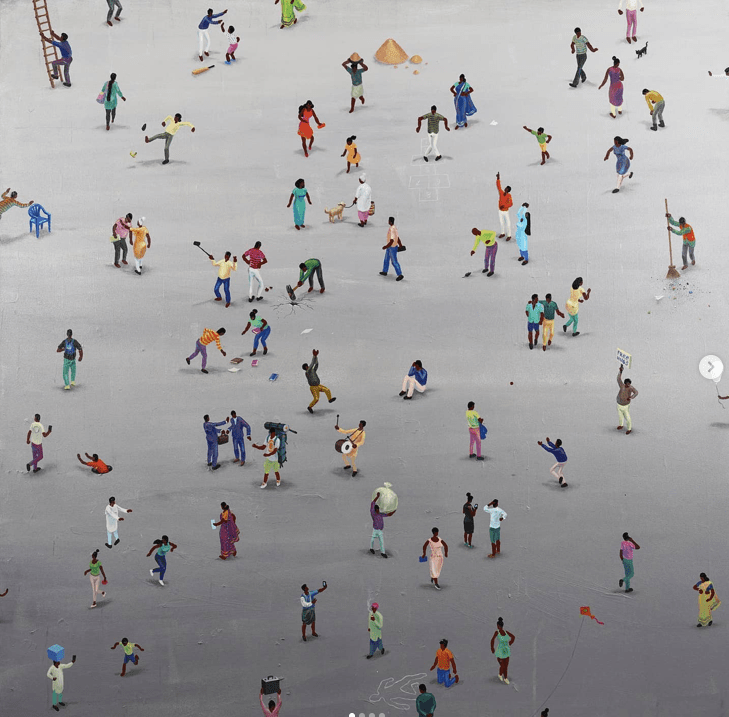
feature image: Simryn Gill, ‘Water Drawing #17‘, 2021, ink on paper. This drawing project is prompted by Charles Darwin’s 1837 sketch ‘Tree of Life’ in which he scribbled down a framework for his speculations in one of his early ‘transmutation’ notebooks. This intuitive drawing of an evolutionary tree is headlined by the words “I think” and is a precursor to Darwin’s radical theory of evolution, common descent, differential survival and natural selection.Kallat invites artists and audiences to consider if Darwin first wrote the words “I think” and then – when words could not capture his emergent thoughts – proceeded to draw, or if the drawing preceded the words. above image: from @indiaartfair, via ritukumarhq; ‘India is known as a glorious melting pot of people, cultures, and beliefs. Diversity and equality are fundamental to our founding principles.’

I am constantly fascinated by Hispanics, who, upon meeting one another, naturally erupt into Spanish, stranger or not. It would be unconventional for me to partake in something akin, regardless of being fluent in three South Asian dialects. So much so that if a contemporary greeted me with a ‘Namaste,’ I would be puzzled.

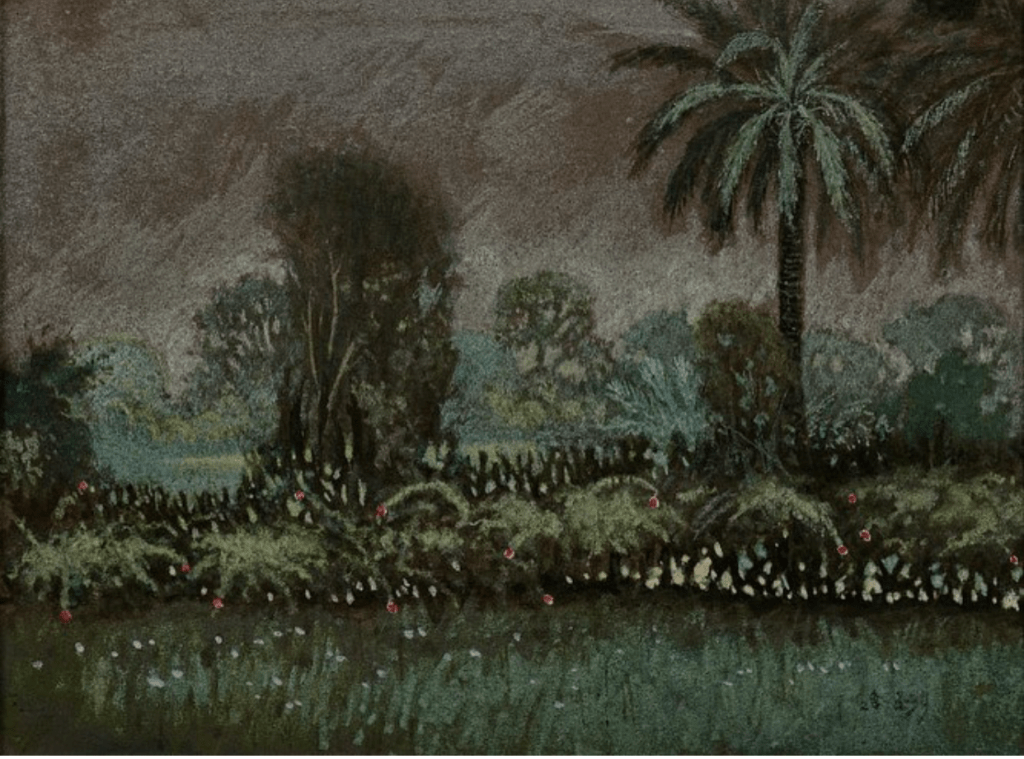
above image: galleryveda, artist: Ganesh Selvaraj “As an act of interpretation, we approach a visual and apply a metaphor. So first, we see a reference, and then we try to interpret it

Language imparts culture, but our mundanity sublimates our heritage. Indians dispose of Styrofoam and redistribute takeout in proper serve-ware when hosting. Ukrainians disdain the legal formality names evoke thus Aanya transforms to Aan-ichka. Similarly, Latinos add suffixes’: Juan-ito, Hernan-cito, Ev-ita, and Laur-ita, diminutive sounding forms yielding a burst of love. And when Persians meet, it’s customary to inquire how relatives are faring; this can last up to an hour.

I would like to believe generations have taken turns depositing small aggregates of an immutable sense of who we truly are.
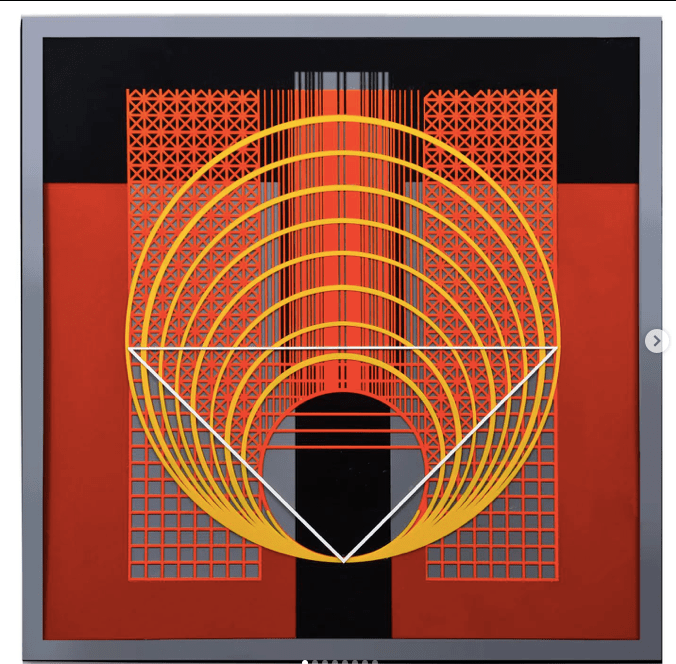
above image: galleryveda, artist: Alagarraja ponniyah. In his works he represent the timeline in the minds of the viewers to reflect our history, present, and our future. He used reflective materials to not only reflect the objects placed before it, but also human emotions and constant changes of time. It depicts the visuality of human emotions in today’s world. He believes that if the world is a mirror of our inner world, any emotion we experience in our world is a reflection of our thought patterns and actions. The mirroring phenomena he explores are also the dualities of history and future, technology and environment.

Migrated

When Barak Obama first campaigned, some were disgruntled as his ancestors lacked the history of slavery as theirs. Their matching skin tones was not enough of a bond—communal suffering has the power to bind. Trauma becomes the hallmark with which they recognized one another, as with the numeric sequences on the camp survivors.

feature image: ‘Transit’ by Vala B Shende Made up of thousands of steel discs welded together, the work depicts 22 laborers in a life size truck. The rear view mirror of the truck displays footage of roadways giving the illusion of movement, but as Shende says ‘they aren’t really going anywhere.’ The piece which was conceived as a comment on migration and urbanization holds even more relevance today amid the continuing migrant crisis we find ourselves in. Is the truck carrying laborers into the city or are they in-fact being forced to leave? Shende’s father was a scrap metal merchant and the metal discs have become his signature, his language as he calls it. The shape to him representative of molecules  and the reflective ability allowing the viewer to see himself in the pieces. above image: from the book Watan, which explores both sides of the Punjab by Graciela Magnoni. “One thing that was clear to me after so many trips to Punjab is that after 75 years of separation, both sides still miss each other and long for connection.”

What is intriguing is no matter how much we orient ourselves differently than our forbearers, we seem to be in a perpetual state of ‘dis-orientation,’ relentlessly trying to capture our cultural legacies. This was evidenced by a friend’s Chicagoan father, who fiercely devoured news of India while unaware of American breaking news headlines. Contrarily, another, having friendships that spanned decades, yearned for a Caucasian fraternity in Toronto.
A quiet reminder that acceptance does not always translate to belonging.
Now a private literary club member, one wonders if he is taunting the WASP majority to look beyond his skin color and recognize their similarities.

With tears welling up, my brother’s mother-in-law once shared how children called her DP a “displaced person” in school. The Irony being she is Canadian-born to Slovanian parents and phenotypically white. And yet six decades later, her pain conveys she was never Canadian enough.

above image: ‘Burden’ by Rupy C. Tut. “Silence is a burden women have carried for too long. In this work, I reflect on their silence, their story, and their convenient absence from the narrative we are told.”

When young, the metaphor of Canada being a tossed salad was widely taught. Theoretically, our diverse identities are celebrated, the parts making up the whole mosaic. Though since coined in the 20s, studies illuminate the mosaic is not as horizontal as the diverse architectural figures in city landscapes but relatively vertical where certain groups preside and are overrepresented in influential decision-making positions.

Caught in the cultural shift, new immigrants must decide who they are.
Some stay tethered to their native country, while others’ penchant for assimilation never diminishes.

Above image: A Man Of The Crowd (2017), by Sam Kulavoor titled, instagram

Home-ish

Recently at the Jaipur Literary Festival (JLF) in Toronto, I attended a panel where several authors discussed their thoughts on ‘home’. Sukutu Mehta, spoke of being so disgruntled in his first year when having moved back to Mumbai that he hoped for it to be bombed or swallowed by a tidal wave. He keenly echoed my sentiments.

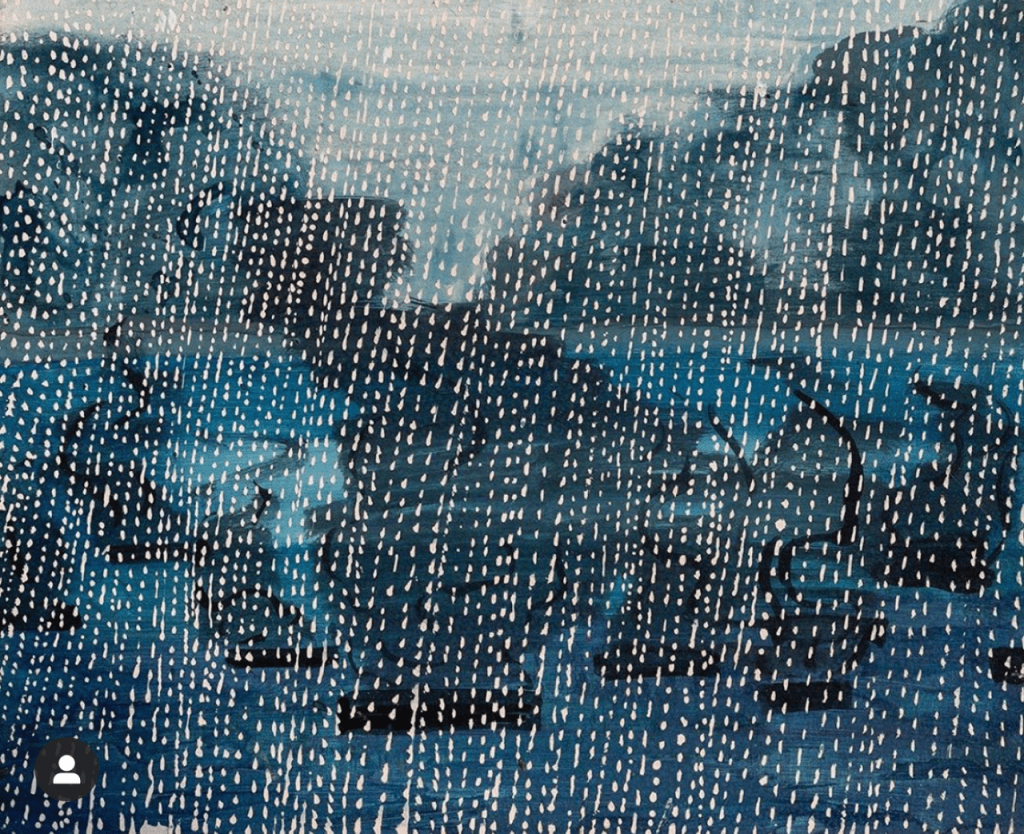
feature image: Switch 2021, part of a collage series, To code-switch is to be multiple and relational, to embody and inhabit difference, to resist claiming origins and refuse the imposition of categories. As a methodology, code-switching is integral to Lubna Chowdhary’s artistic practice which has long sought to stake out a conciliatory middle or common ground between various binaries: art and craft, East and West…’ — excerpt from Murtaza Vali. (L) Mumbai rains, image: Punit Paranjpe, image by, Hasan Mahmud Prottay, (R) Mumbai monsoon in 1983. God please stop this, by Mahesh Baliga


After I left Toronto, I longed for it, and was perturbed by the realization of how integral to my essence it was. Eventually, I became ambivalent because I neither partook in nor was witness to the direction of change; then bitterness set in as the evolution had rendered the city unrecognizable.

What is it about ‘home’ that can betray? We desire progression but we crave a nostalgic type of Ekphrasis. If Toronto is global, Scarborough is hyper-cloistered.
Toronto, now a world-class destination has a vast foreign footprint that has effectively redefined the city.
Alternatively, Scarborough is touted as a place for authentic cultural culinary cuisine. Hand pulled Uyghur noodles can be found down the road from a Jamaican patty shop, juxtaposed to a Sri Lankan sari boutique.  A short distance lies apartment buildings —- with parking lots used by Punjabi farmers to sell amongst other things, the most fragrant cilantro. All this, arguably a healthy breeding ground for all cultures imparting a sense of ‘home’.

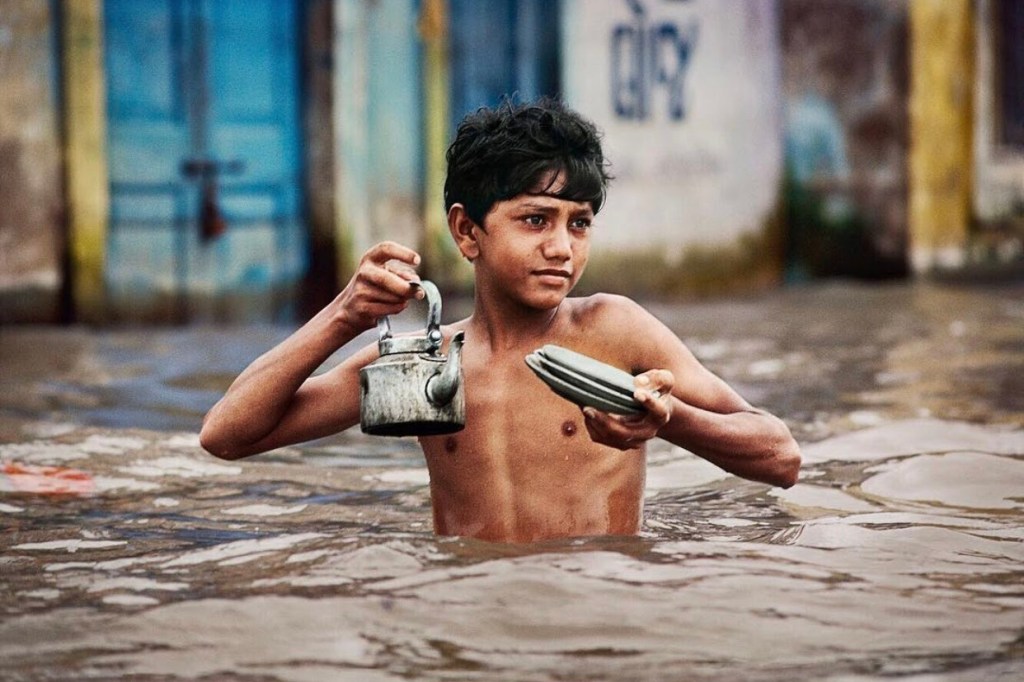
(above image) A chaiwalla carries a tea kettle in waist deep monsoon water, by Steve Mccury,


Interestingly I desired the opposite growth in each. I wished for Scarborough to be more than just culturally determined, and for Toronto to cease becoming predictable and uniform.

(above image) by Siddharth Dasari; he photographed close to 350 buildings during his stay in Copenhagen to get a sense of how different neighborhoods evolved, how they perceived color and how housing was planned. source @artandfound.co

Mataji.

As a child, I bemoaned the reality that Mataji never embodied the saccharine sweetness of fictional grandmothers: demonstrative of love, bestowing excess candies, and unvigilant of rules–essentially a complete antithesis to grandmothers.
Yet our house contradicted these conventional norms; it’s as if some imaginary force exacted a role reversal between my mother and my grandmother. In fact it was my mother who did the spoiling, while Mataji who lived a disciplined lifestyle saw no reason why a child need not follow the same rigors, thus a Vedic wizard was created well versed in all the mantras necessary to perform havans by the age of eight. In addition to this, her manner of tutoring was steeped in rote memorization. Ensuring her teachings weren’t in vain, she implemented a ritual for memory enhancement requiring me to consume five blanched almonds every morning—five was the prescribed number for children and seven for adults. Loving this part of my regime, I looked forward to being promoted to adult status but alas children never get old and well into my twenties I was still given five almonds. Had I lived at home she too would never get old to me but I had the miserable burden of recognizing her fragility every time I visited and yet she walked on her own, while the walker stayed stationed at its post unmoved from my last visit.

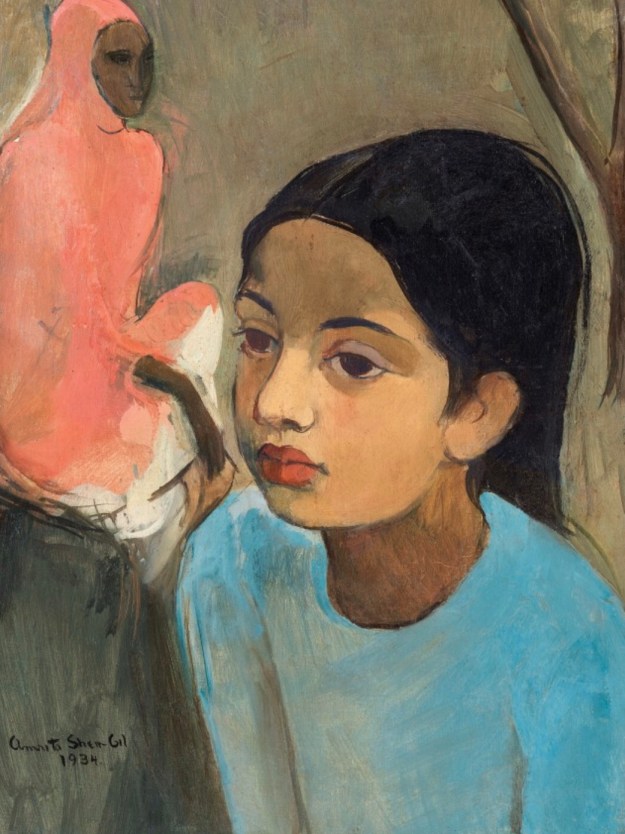
Amrita Sher-Gil 1913 – 1941
THE LITTLE GIRL IN BLUE

Born in 1913 in Budapest, Sher-Gil grew up in a cultured and intellectual family who initiated and supported her early interest in art. Her mother was a Hungarian-Jewish opera singer and her father was an Indian Sikh aristocrat and scholar. She lived in Hungary, India and Paris during her lifetime, and her art embodies a bohemian combination of east and west.     

image; Sotheby’s

Mataji was part of a generation of women who were unapologetically tough, running households consisting of extended family members, and appropriating money for that which was essential –I was once told that mistakes in notebooks were corrected with soles of slippers because they were avatars of the erasers. it was with this very same prudence I thought she displayed her affections, not being cognizant that unlike my six year old neighbour who cleaned the house and cooked dinner, I was omitted from having such responsibility that my once precocious grandmother and neighbour shared. It is heart breaking that so much love can exist and be unnoticed. However, attention was not what she seeked nor validation, which is why only after her death was her benevolence with the red cross society, valour in aiding wounded soldiers and involvement in finding shelter for abused women (during Partition), came to light. Such was her comfort with self and confidence in truth that years before when someone usurped my father’s trials and tribulations (when having left India) as their own, Mataji held a quiet reserve as she unfailingly knew that her son was the true heir of those experiences.

The night when Mataji first arrived to Toronto twenty-five years ago, she entered the house with my father carrying her brown suitcase.  Ironically after her passing, when surveying her possessions there was no more than could be fitted into that very suitcase.   It’s as if her whole life was just us.  

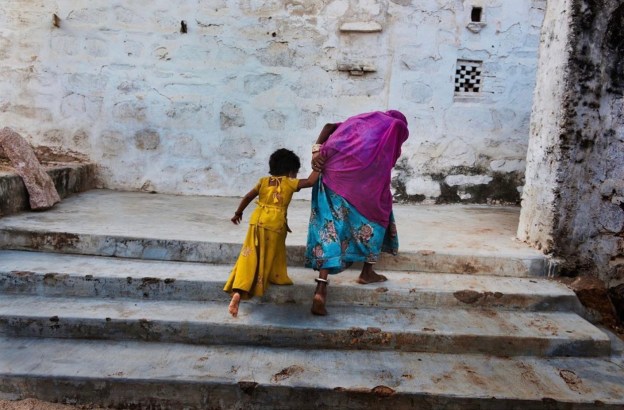
feature image: photograph by Steven McCurry